Guinea at a Glance Facts, Figures and Essential Information About the Republic of Guinea
Every country has a story.
Before exploring Guinea's mountains, forests, history, wildlife and cultures, it helps to understand the essential facts that define this remarkable West African nation.
The Republic of Guinea is a country of extraordinary contrasts: a place where Atlantic coastlines meet ancient forests, where mountain rivers begin journeys across West Africa, and where centuries of history continue to shape modern life.
Known for its natural wealth, cultural diversity and important role in West African history, Guinea remains one of Africa's most fascinating countries.
This overview provides a starting point for discovering Guinea.
🇬🇳 Official Name
Republic of Guinea
French name:
République de Guinée
The country is often simply called Guinea.
Because several countries around the world share similar names, it is sometimes referred to as:
- Guinea-Conakry
- the Republic of Guinea
This helps distinguish it from:
- Guinea-Bissau
- Equatorial Guinea
Location
Guinea is located in West Africa, on the Atlantic Ocean.
It shares borders with:
- Senegal to the north
- Mali to the northeast
- Côte d'Ivoire to the southeast
- Liberia to the south
- Sierra Leone to the southwest
- Guinea-Bissau to the northwest
Its Atlantic coastline gives Guinea an important connection between inland West Africa and the ocean.
Capital City
Conakry
Conakry is the capital and largest city of Guinea.
Located on a peninsula along the Atlantic coast, the city is:
- the political centre of the country
- the main economic hub
- a cultural centre
- an important port city
Conakry is home to:
- government institutions
- museums
- markets
- universities
- cultural venues
It is also the gateway through which many international visitors first experience Guinea.
Population
Guinea has a population of approximately 14 million people.
The population is young and culturally diverse, with many communities contributing to the country's identity.
Major population centres include:
- Conakry
- Kankan
- Kindia
- Labé
- Nzérékoré
- Mamou
A significant part of the population lives in rural areas, where agriculture and traditional community life remain important.
Area
Guinea covers approximately:
245,857 square kilometres
The country is larger than many people realise and contains several distinct geographical regions.
Geography: Four Natural Regions of Guinea
Guinea is traditionally divided into four major geographical regions.
1. Maritime Guinea (Lower Guinea)
The Coastal Region
Located along the Atlantic Ocean, Maritime Guinea includes:
- Conakry
- coastal plains
- mangrove ecosystems
- islands and fishing communities
This region is characterised by:
- tropical coastal landscapes
- important ports
- fertile agricultural areas
It is the country's connection to the Atlantic world.
2. Middle Guinea (Fouta Djallon)
The Mountain Heart of Guinea
Fouta Djallon is one of Guinea's most famous regions.
Known for:
- mountains
- waterfalls
- valleys
- forests
- rivers
The region is also historically important as a centre of Islamic scholarship and Fulani culture.
Many major West African rivers begin here.
3. Upper Guinea
The Savannah Region
Upper Guinea is characterised by:
- savannah landscapes
- major rivers
- agricultural areas
- historic connections with the Mandé world
The region has strong links with the history of West African kingdoms.
4. Forest Guinea
The Green Southeast
Forest Guinea contains some of the country's richest biodiversity.
It is home to:
- tropical forests
- Mount Nimba
- Ziama Biosphere Reserve
- important wildlife habitats
The region is particularly important for conservation.
Highest Mountain
Mount Nimba
Elevation:
approximately 1,752 metres
Mount Nimba is the highest point in Guinea.
Located in southeastern Guinea, the mountain is famous for:
- extraordinary biodiversity
- unique species
- dramatic landscapes
It is one of Guinea's most important natural landmarks.
Major Rivers
Guinea is often called the water tower of West Africa because several important rivers originate within its territory.
Major rivers include:
Niger River
One of Africa's greatest rivers.
Its source region is located in Guinea's highlands.
Senegal River
Important for communities across several West African countries.
Gambia River
Another major river beginning in Guinea.
Konkouré River
A major Guinean river associated with waterfalls and hydroelectric development.
Climate
Guinea has a tropical climate influenced by its geography.
The main seasons are:
Rainy Season
Generally from approximately May to October.
Characteristics:
- heavy rainfall
- green landscapes
- powerful waterfalls
- flowing rivers
Dry Season
Generally from approximately November to April.
Characteristics:
- warmer conditions
- clearer skies
- easier travel in many regions
Climate varies considerably between the coast, mountains and interior.
Official Language
French
French is the official language of Guinea and is used in:
- government
- education
- administration
National Languages
Guinea is a multilingual country.
Major national languages include:
- Pular
- Maninka
- Susu
- Kissi
- Guerzé
- Toma
- Baga languages
These languages preserve important cultural knowledge and traditions.
Currency
Guinean Franc (GNF)
The official currency is the Guinean franc.
Time Zone
Guinea uses:
Greenwich Mean Time (GMT / UTC+0)
The country does not observe daylight saving time.
National Symbols
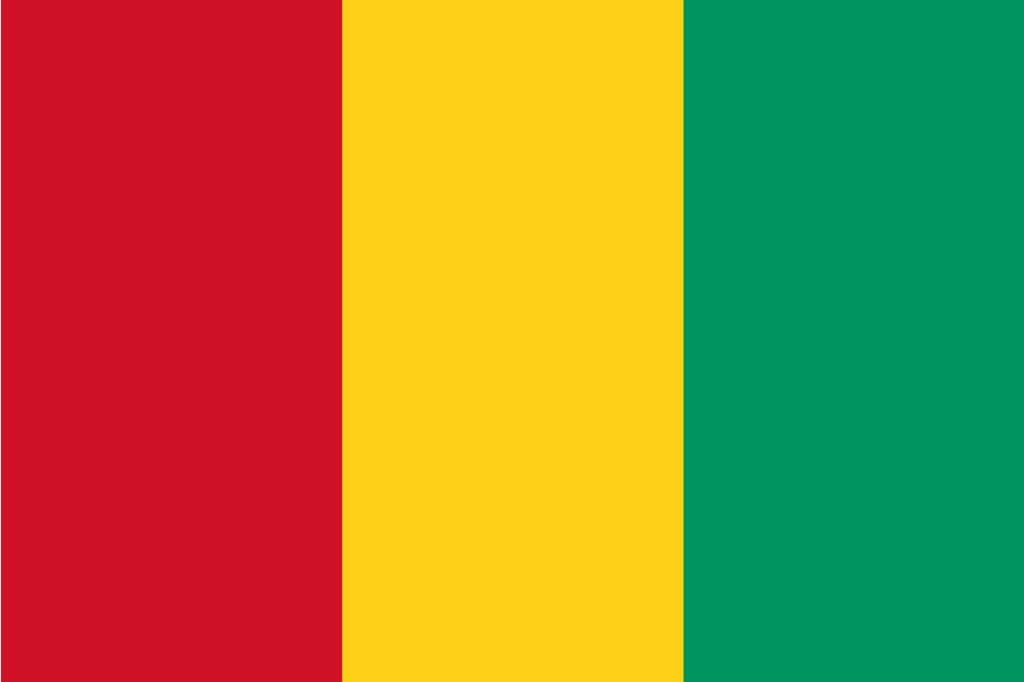
Flag of Guinea
The national flag consists of three vertical colours:
- Red
- Yellow
- Green
These colours represent important national values and the country's African identity.
National Motto
Travail, Justice, Solidarité
("Work, Justice, Solidarity")
National Anthem
Liberté
The anthem reflects themes of freedom, unity and national pride.
Government
Guinea is a republic.
The country has:
- a president
- government institutions
- national administrative structures
The capital, Conakry, is the centre of national government.
Economy
Guinea possesses significant natural resources.
Important economic sectors include:
Mining
Guinea has some of the world's largest reserves of:
- bauxite
- iron ore
- gold
Agriculture
Agriculture remains essential for many communities.
Important products include:
- rice
- coffee
- fruits
- vegetables
- livestock
Fisheries
The Atlantic coastline supports important fishing activities.
Natural Heritage
Guinea's natural treasures include:
- Mount Nimba Strict Nature Reserve
- Haut Niger National Park
- Ziama Biosphere Reserve
- Fouta Djallon landscapes
- coastal wetlands
The country is one of West Africa's most important biodiversity regions.
UNESCO Heritage
Guinea is associated with internationally recognised heritage sites, including:
Mount Nimba Strict Nature Reserve
Recognised for exceptional natural importance and biodiversity.
Wildlife Highlights
Guinea is home to:
- western chimpanzees
- hippos
- forest elephants
- monkeys
- rare birds
- unique amphibians
Important species include:
- White-necked Picathartes
- Nimba Flycatcher
- Rufous Fishing Owl
- Yellow-bearded Greenbul
Cultural Highlights
Guinea's cultural identity is shaped by:
- music
- dance
- storytelling
- traditional crafts
- festivals
- languages
The country's heritage includes influences from:
- Mandé traditions
- Fulani history
- coastal cultures
- forest communities
Famous Guineans
Guinea has produced influential figures in:
- politics
- music
- literature
- sport
- culture
Future Guineapedia articles will explore many of these personalities in greater depth.
Why Guinea Matters
Guinea is much more than a country rich in natural resources.
It is a nation of:
- ancient histories
- extraordinary landscapes
- diverse cultures
- remarkable biodiversity
- creative traditions
Its rivers have shaped West Africa.
Its musicians have influenced generations.
Its forests protect rare species.
Its people preserve traditions that have survived for centuries.
Continue ReadingGUINEAPEDIA Tips – Explore Guinea
Discover Guinea
Guinea is not a destination that can be reduced to a list of attractions.
It is a country to experience.
Its beauty lies not only in what visitors see, but in what they learn, who they meet and how the journey changes their understanding of West Africa.
For travellers seeking nature, culture, history and genuine human connection, Guinea offers something increasingly precious:
A place where discovery is still possible.
🇬🇳 Guinea Independence Day